As in many other Asian countries, Viet Nam's Intended Nationally Determined Contribution (INDC) explicitly mentions rice production as one of the targets for mitigation in the agriculture sector.
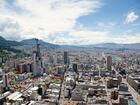
Cities – including their governments, inhabitants, communities and commercial and industrial actors – are essential to building a renewables-based economy, and their active participation is critical to define and implement a system-wide energy transition at the local, national and global levels. REN21’s Renewables in Cities 2021 Global Status Report provides and overview of trends and developments of renewable energy in cities, examiningurban policy landscapes, market and infrastructure developments, investment trends and opportunities for citizen participation.
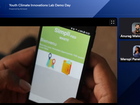
On Earth Day, eleven selected startups from Africa and Asia Pacific were pitching their technology solutions for enhanced climate action across the two regions. The UN Climate Technology Centre and Network (CTCN), in partnership with SAFEEM and Seedstars, hosted the Youth Climate Innovation Lab Demo Day.
The Climate Technology Centre and Network (CTCN) organized two webinars to share early lessons from the first call for submission of applications to the Adaptation Fund Climate Innovation Accelerator (AFCIA) programme. The third webinar for Africa is planned later in May.
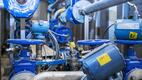
Sjöstadsverket Water Innovation Centre (SWIC) is Sweden's leading and internationally known R&D facility in water purification technology. Different mobile devices and purification steps can be connected to the various water treatment lines to compare and develop future technologies. The innovative water treatment center is owned and operated by a consortium led by the Royal Institute of Technology (KTH) and IVL Swedish Environmental Research Institute.
Svenska Statoil AB runs a small-scale district heating plant in Duvnäs Utskogen that was converted from fossile oil to biomass in 2003. Here, 2 pellets boilers of 600 kW each produce 4300 MWh of heat per year, supplying a residential area with 238 houses.
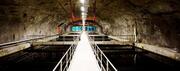
Käppalaverket is one of the world’s most efficient wastewater treatment plants, treating wastewater from more than 500,000 inhabitants in Stockholm. Here, the purification proess is turning waste to new resources, in the shape of biogas fuel as well as heat. Käppalaverket is an underground facility, situated in the north-eastern part of Stockholm. Annually, the plant purifies about 50 million cubic metres of wastewater from households, schools, industries, offices and hospitals.
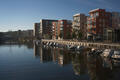
In the early 1990s, Hammarby Sjöstad had a reputation for being a run-down, polluted and unsafe industrial and residential area. Today, Hammarby Sjöstad is one of Stockholm’s most attractive residential districts and a model of successful urban renewal. Sustainability was one of the primary focal areas in the design and planning of Hammarby Sjöstad. The ambitious sustainability goals were integrated into the planning process from the initial phases. Sustainable alternatives for managing water, energy and waste were carefully studied from the architectural and infrastructure design stage.
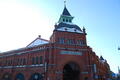
A vacuum system handles the waste in Östermalm’s food market hall. The waste is transported via pipelines by means of under pressure to a storage unit, and later to a biogas installation. Östermalmshallen, a traditional food market hall in central Stockholm, has installed a vacuum waste system which removes the huge amounts of waste generated in the market hall. With this system all manual handling has been eliminated and the waste is turned into an important environmental resource.
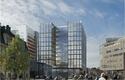
Kungsbrohuset and Stockholm Waterfront Congress Centre are two examples of intelligently designed buildings that bring together a number of efficiency solutions to slash energy consumption. From the reuse of construction materials to the use of energy-generating glass facades, Stockholm Waterfront Congress Centre is designed to cut CO2 emissions and minimise climate and environmental impact. Located between Stockholm Central Station and Stockholm City Hall, the congress centre was built in 2011 and comprises 72,000 sqm of space, with conference halls, offices and a hotel.