News facts
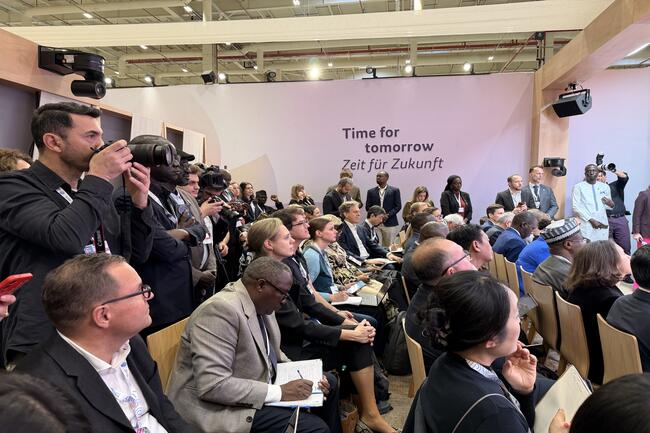
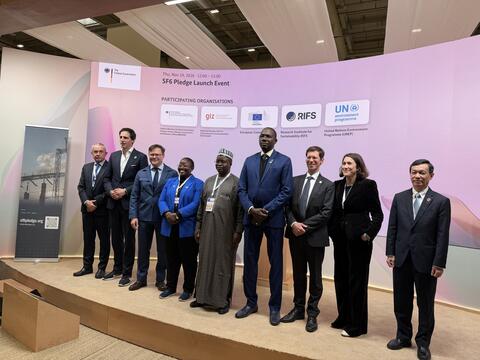
The UN Climate Technology Centre and Network (CTCN) joined Germany and international partners at COP31 to launch the Global SF6 Pledge, reinforcing its commitment to support developing countries into a coordinated effort to curb the world’s most potent greenhouse gas: Sulphur Hexafluoride (SF6).
Launched at COP31, the SF6 pledge addresses an overlooked risk: electricity grids built to support the clean energy transition could lock in decades of emissions from SF6, a gas widely used in electrical equipment in energy grids. CTCN has been supporting countries on SF6 since 2023 and will build on this work to help turn the pledge into action, with technical expertise, training and support so they can adopt SF6-free technologies.
SF6, used to insulate electrical equipment like switchgears and circuit breakers, has a global warming potential equivalent to 24,300 times that of carbon dioxide over 100 years. The gas remains in the atmosphere for more than 1,000 years, making small leaks a lasting climate liability.
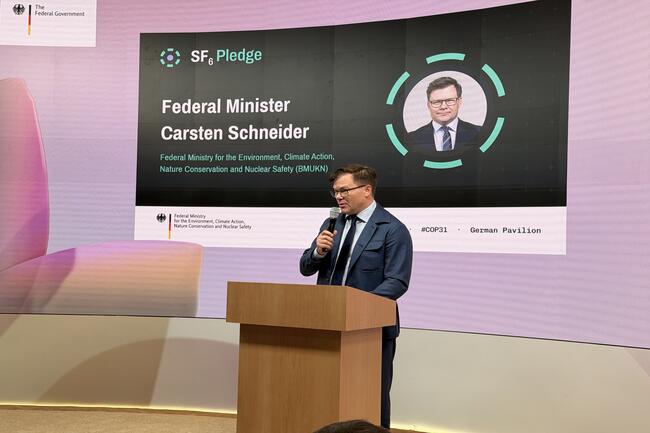
Signatories at the event committed to improve data on installed SF6 and emissions, minimize releases through environmentally sound management, and encourage cleaner SF6 -free technologies. Germany’s Federal Environment Minister Carsten Schneider opened the launch.
Kenya and Senegal have announced their endorsement of the pledge, with facilitation from CTCN, which places them among the pioneering countries in Africa to address SF6. This step builds on CTCN technical assistance in Kenya and Senegal, which helped both countries understand the scale of the challenge, find practical solutions, and build the confidence and urgency to act.
The projects are helping governments and utilities establish inventories, improving monitoring, strengthen safe gas management, and assess alternatives suited to their grids. The SF6 Knowledge Hub also provides a growing collection of case studies and guidance materials to learn about SF6 and engage with the CTCN and partners.
“Countries need electricity grids that expand energy access without locking in avoidable emissions,” said Ariesta Ningrum. “Our work in Kenya and Senegal shows where action starts, knowing how much SF6 is installed, training the people who manage it and identifying suitable alternatives. The pledge and our involvement in the Global SF6 Initiative now creates the momentum to go beyond these individual efforts and build an ecosystem in which more countries can take these steps and connect their plans with the partners and finance needed for implementation.”
SF6 -free equipment is commercially available for most voltage levels. Better leak prevention, recovery, and recycling can also reduce emissions from existing equipment. Scaling these solutions requires expertise, enabling policies and finance.
The pledge is backed by the international SF6 initiative, implemented by CTCN, Deutsche Gesellschaft fur International Zusammenarbeit (GIZ) Gmbh and the World Bank’s ESMAP and SCALE programmes, with support from Germany’s Environment Ministry and International Climate Initiative. Further supporters of the SF6 Pledge are the Climate and Clean Air Coalition, the Green Grids Initiative and the German Environment Agency.
More governments and organizations are invited to join. CTCN will help connect national needs with the right technologies, skills and partnerships to turn growing political momentum into measurable emissions reductions.