News facts
A climate adaptation solution piloted in Burundi with support from the Adaptation Fund Climate Innovation Accelerator (AFCIA) is set to expand following the approval of USD 5 million from the Adaptation Fund. The investment will scale up an approach that uses portable, water-filled barriers to protect farmland and communities from floods while storing water for use during dry periods.
Approved by the Adaptation Fund Board on 23 October 2026, the four-year project aims to directly benefit almost 360,000 people across Mpanda, Bubanza and Bukinanyana.
Launched in 2020, AFCIA is an Adaptation Fund initiative that provides small grants and technical assistance to advance innovative climate adaptation solutions in developing countries. It helps address a persistent challenge: promising ideas often struggle to attract the finance needed to grow before they have been tested and shown to work in local conditions.
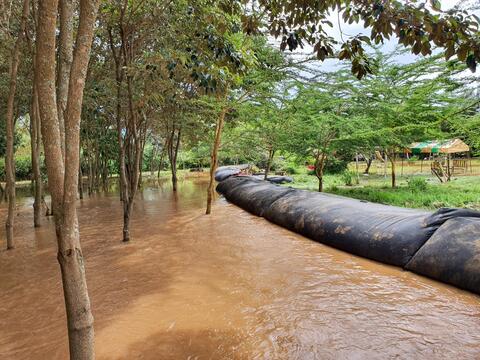
In Mpanda, north-western Burundi, the original pilot demonstrated how one technology could help farmers manage both flooding and water shortages. The pilot used a flexible rubber barrier known as SlamDam. Filled with water, it forms a temporary flood defense; the stored water can later support irrigation.
The solution has also gained international recognition. WaveSave, the company behind SlamDam, was selected as one of seven winners of the Trust for Governors Island’s 2026 Climate Solutions Challenge in New York City. MIT Technology Review also named WaveSave among its 10 Climate Tech Companies to Watch in 2026, highlighting the barrier’s combined role in flood protection and water storage.
“The expansion illustrates AFCIA’s role in helping adaptation innovations progress towards larger investment”, says Nadege Trocellier, the Climate Adaptation Lead at CTCN. “By funding pilots and demonstrating how solutions perform in practice, AFCIA helps generate the evidence that governments, donors and investors need to assess their potential.”
“For me, the real value of climate innovation is measured by the impact it has on people's lives,” says Omar Saleh, Managing Director of WaveSave. “An independent evaluation of our pilot in Burundi exceeded our expectations. The mobile barrier was primarily intended for flood protection, but communities valued its combined use for irrigation. Farmers cultivated 48 hectares, including during the dry season, improving harvests and livelihoods.”
“This new investment gives us the opportunity to build on those results and bring similar benefits to many more communities.”
About AFCIA
AFCIA brings together programmes managed by CTCN, the United Nations Development Programme (UNDP), the United Nations Industrial Development Organization (UNIDO), the World Food Programme (WFP) and the Pacific Community (SPC). Together, these programmes support the development, testing and scaling of solutions that help vulnerable communities adapt to climate change. Learn more.