News facts
Senegal launched today its national cement and concrete decarbonization roadmap at COP31, demonstrating how technical assistance from the UN Climate Technology Centre and Network (CTCN) can help developing countries turn climate ambition into a practical agenda for industrial transformation.
Unveiled at the COP31 side event "Global Goals, Local Action: Powering the Carbon Transition in the Global South," the roadmap sets a pathway to carbon neutrality by 2050 for a sector essential to Senegal's housing, infrastructure and economic development. Its launch marked a major milestone in CTCN's support to the country, funded by the European Union.
Developed between July 2025 and October 2026, the roadmap was led by Senegal's Ministry of Industry and Commerce, the Ministry of Environment and Ecological Transition and all four cement producers: Sococim, Ciments du Sahel, Dangote Ciments Sénégal and CIMAF. Workshops using the Global Cement and Concrete Association's (GCCA) industry-led methodology helped translate the assessment into priorities grounded in Senegal's resources, market conditions, and development needs.
"For the first time, the government and Senegal’s entire cement industry share a common pathway to carbon neutrality, one that turns our NDC commitments into concrete measures. Decarbonizing cement is not a constraint on our development. It is an opportunity to strengthen our industry by using our own clay resources and turning waste and renewable biomass into fuel. We now count on our partners to help mobilize the investment this transformation requires," said H.E. Aliou Gori Diouf, Minister of Environment and Ecological Transition, Senegal.
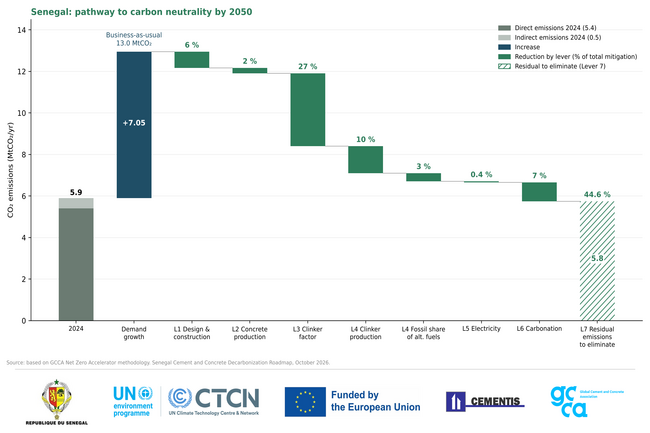
The stakes are substantial. Senegal's cement sector emitted approximately 5.9 million tons of CO₂ in 2024. Without action, rising demand could push emissions to 13 million tons by 2050.
Aligned with Senegal's Nationally Determined Contribution, the roadmap identifies seven decarbonization levers and 39 measures. The largest lever is reducing cement's clinker content from 72% to 45% by 2050, principally through limestone calcined clay cement (LC3) using local clay. Other measures include alternative fuels and biomass, renewable electricity, and carbon criteria in public procurement.
"Senegal's roadmap shows the value of technical assistance that connects national priorities with technology expertise and brings government and industry together around a shared direction," said Ariesta Ningrum, Director of CTCN. "As Parties gather at COP31 to advance climate action, the focus must increasingly shift from ambition to implementation. Through our support, we are helping countries identify solutions suited to their circumstances and measures needed to put them into practice. The priority now is to mobilize the partnerships and finance that will turn this roadmap into lasting emissions reductions."
Implementation will now centre on scaling LC3 and increasing alternative fuel use, including through better waste and biomass collection. Mobilizing investment and establishing an enabling policy framework will be essential.
The event was organized by GCCA on 13 November 2026 on the sidelines of COP31 which this year is being held in Antalya, Türkiye. The side event placed Senegal's milestone within the broader challenge of green industrialization across emerging markets and developing economies. Bringing together government, industry, technology cooperation, and finance perspectives, it explored how national pathways can make low-carbon cement commercially viable while supporting competitiveness and growing infrastructure needs.
The discussion underscored the critical role of CTCN’s technical assistance in translating national climate priorities into locally tailored solutions and pathways for industrial decarbonization. Senegal’s roadmap now provides a shared agenda for action. Governments, industry, and financing partners must build on this foundation by strengthening enabling policies, investing in low-carbon technologies, and mobilizing climate finance to turn the roadmap into measurable emissions reductions.