News facts
The CTCN is seeking experts to participate in the upcoming solicitation to provide technical assistance on:
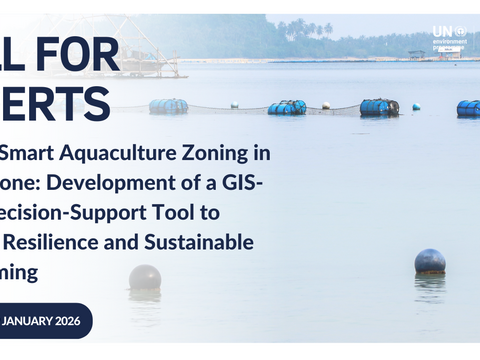
Climate-Smart Aquaculture Zoning in Sierra Leone: Development of a GIS-Based Decision-Support Tool to Enhance Resilience and Sustainable Fish Farming
Deadline: 19 January 2026
Sierra Leone faces increasing climate-related threats, including more variable rainfall, rising temperatures, intensified flooding, sea-level rise, and saltwater intrusion, with climate projections indicating that these trends will worsen toward the end of the century. Aquatic ecosystems and aquaculture systems are particularly vulnerable: erratic precipitation and prolonged dry spells disrupt water availability and quality in inland fish farms, while coastal aquaculture is increasingly exposed to flooding, erosion, and salinity changes. These impacts undermine productivity, damage infrastructure, and increase risks for smallholder and commercial aquaculture investments.
Although national strategies such as the Feed Salone Strategy and climate policy instruments, including the NDCs and NAPA, recognize the importance of climate-resilient aquaculture, significant gaps remain in climate-informed spatial planning. In particular, the lack of integrated, high-resolution environmental and climate data, combined with the limited use of GIS-based decision-support tools, constrains effective aquaculture zoning and site selection. As a result, aquaculture development often proceeds without adequate consideration of current and future climate risks, reducing sustainability and long-term returns.
Through the CTCN, Sierra Leone will strengthen its technical and institutional capacities to generate, integrate, and apply climate, environmental, and socio-economic data for climate-smart aquaculture zoning. The technical assistance will support evidence-based decision-making by enabling national institutions and extension services to identify suitable and non-suitable areas for aquaculture development under present and projected climate conditions. Some of the expected outputs are:
- Generation of climate-informed aquaculture suitability maps integrating hydrology, flood risk, soil characteristics, land use, and climate projections;
- Technical assessment of climate-resilient aquaculture zoning options, including feasibility, sustainability, and potential for replication at national and sub-national levels;
- Development of a GIS-based decision-support tool and associated capacity-building materials to support implementation and long-term use by national agencies.
For further information on this opportunity, visit the UN Global Market Place (UNGM) or the UN website.
If you are not yet a member of the CTCN Network, you can apply to join here.