News facts
Addis Ababa, Ethiopia, 6-8 July 2026 – The Africa Dialogue on Cement for Green Industrialization concluded today with a call to accelerate practical action on low-carbon cement and concrete as Africa enters a defining period of urban growth, infrastructure development and industrialization.
Hosted by the Ministry of Industry of Ethiopia and jointly organized by the United Nations Industrial Development Organization’s (UNIDO) Net Zero Partnership for Industrial Decarbonization, together with the Climate Club’s Global Matchmaking Platform, the Global Cement and Concrete Association, UNEP-hosted Climate Technology Centre and Network, EPFL and the Konrad-Adenauer-Stiftung. The three-day Dialogue brought together more than 110 participants from 39 countries, including 23 African countries. Government representatives, cement producers, industry associations, financial institutions, investors, international organizations, research institutions, civil society and youth representatives examined how Africa can meet growing demand for cement while avoiding carbon lock-in and supporting competitive, resilient and locally rooted industrial development.
With around 80 per cent of Africa’s 2050 building stock yet to be constructed and the continent’s cement production expected to increase significantly in the coming decades, participants stressed that decisions taken today will shape emissions, infrastructure and industrial competitiveness for generations.
The Dialogue focused on solutions that are already available and can be scaled, including reducing the clinker content of cement through supplementary cementitious materials and LC3, improving material efficiency in construction, increasing the use of alternative fuels, strengthening measurement and reporting systems, and creating markets for low-carbon materials through standards, building codes and green public procurement.
Ato Melak Alebel, Minister of Ministry of Industry of the Federal Democratic Republic of Ethiopia: “Climate change knows no borders. If the world's most industrialized nations are struggling to adapt to record heatwaves and extreme weather, the urgency for Africa to build resilient, future-proof economies is absolute. Our response must be ambitious, practical, and rooted in sustainable industrial growth.”
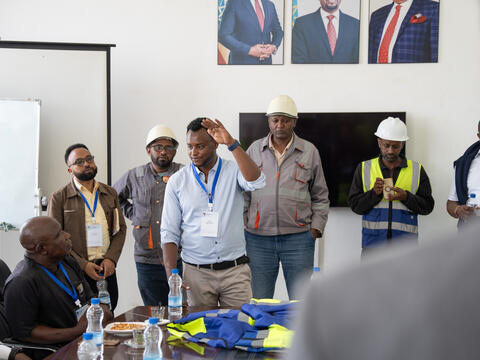
The Dialogue opened with a site visit to Habesha Cement Plant and addressed markets, policy, finance and implementation for low-carbon cement. Participants examined MRV, standards, procurement, building codes, circularity and country experience; heard youth calls for faster, accountable action; and explored blended finance, Article 6, de-risking and partnerships through an interactive project marketplace.
Stephen Kargbo, Director of the UNIDO Sub-Regional Office and Representative to Ethiopia, the African Union and UNECA: “Every bag of cement we choose today is a vote for the kind of Africa we will live in tomorrow. The decisions we make today will lock in emissions for the next half century. If we embed low-carbon norms now, Africa can industrialize sustainably, attract green investment, and equip its youth with the skills to lead tomorrow's construction sector.”
Thomas Guillot, Chief Executive of the GCCA, said: “Africa is experiencing rapid urbanisation. With around 80% of its 2050 building stock yet to be constructed, cement demand across the continent is projected to increase dramatically in the coming decades, which is why it is vital to have regional dialogues across government, industry and other key stakeholders to discuss decarbonisation in the local context. This week, we have seen true collaboration in the desire to drive real and meaningful change in the region, but the decisions we make now will lock in industrial pathways for decades and determine the carbon intensity of Africa’s future, and so action is needed now to implement early investment in low-carbon solutions, to strengthen Africa's competitive position and open up new economic opportunities."
Robinson Mugo, CTCN Regional Manager for Africa, UNEP Climate Technology Centre and Network: “The technology is there. The vision is there. And across governments, industry and international partners, there is broad agreement on the direction of travel. But we also agree that there is much more to do. The next step is to connect technologies with the right policies, local capabilities, finance and partnerships so that countries can move from ambition to implementation at scale.”
The Dialogue stressed regional cooperation and knowledge exchange while recognizing differing contexts. Participants identified challenges in finance, technical capacity, data systems, standards and policy alignment. They emphasized that Africa’s transition must build on local materials, regional value chains, African research institutions and domestic capabilities to create competitive, scalable low-carbon cement and concrete solutions.
The Africa Dialogue is the second regional cement dialogue convened by UNIDO and partners in 2026, following the Latin America and the Caribbean Dialogue on the Decarbonization of Cement and Concrete held in Santiago, Chile, in May.
The Dialogue was also organized with the Industrial Deep Decarbonisation Initiative and supported by the International Climate Initiative on behalf of the German Federal Ministry for the Environment, Climate Action, Nature Conservation and Nuclear Safety and the Global Environment Facility.
The press release was originally published on this page.