Network member
Technology sector
Waste management
Website
Focal point email
Problem
Urban growth in Africa poses the double problem of its spontaneity and its rapidity. The annual rate of urban growth in Ouagadougou was around 2.93% per year (RGPH 2020). This pace of urban development creates significant investment needs in the areas of drinking water, sanitation, transport, communication, etc. Solid waste management, a new concept in its content, often remained a non-priority aspect in urban development plans in Burkina Faso. Nowadays, with the growing demand for consumer goods from the Ouagalais population, the rate of waste production per inhabitant has increased considerably and therefore poses an environmental problem. The amount of waste generated is estimated at 1.0 kg/person/day (UNEP-2020). The collection and disposal of household waste is increasingly becoming a constant concern of municipal authorities. Sanitation services, transfer and disposal services involved in the collection of urban waste are insufficiently functioning. In 2020, 680,000 tonnes of garbage were thus produced in the capital, which has some 3 million inhabitants. This is three times more than twenty years ago and around a third of this waste is plastic. Thin polythene bags have become an environmental scourge in Africa, where more than 90% of garbage is dumped in uncontrolled dumps and incinerated in the open, according to the United Nations Environment Program (UNEP). Sanitation services, transfer and disposal services involved in the collection of urban waste are insufficiently functioning. which has some 3 million inhabitants. This is three times more than twenty years ago and around a third of this waste is plastic.
This large quantity of waste produced presents a danger for the environment and for people, especially since the municipality and private cleaning companies only manage to collect 50% of the waste produced.
Food safety is affected by improper handling, preparation and storage of food. Food safety issues lead to product recalls and millions of dollars in food waste. Around 75% of all food waste ends up in landfills, 18% is burned with energy recovery and only 6% is composted. These and other factors make sustainability an essential element of food security. The food supply chain is vulnerable to security and sustainability risks. At every stage of the supply chain (production, processing, retail and disposal), all parties can contribute to improving food safety and sustainability.
In this context of economic crisis that the country is going through, the search for an approach to waste management through recycling and disposal at a lower cost, profitable and effective is necessary.
This large quantity of waste produced presents a danger for the environment and for people, especially since the municipality and private cleaning companies only manage to collect 50% of the waste produced.
Food safety is affected by improper handling, preparation and storage of food. Food safety issues lead to product recalls and millions of dollars in food waste. Around 75% of all food waste ends up in landfills, 18% is burned with energy recovery and only 6% is composted. These and other factors make sustainability an essential element of food security. The food supply chain is vulnerable to security and sustainability risks. At every stage of the supply chain (production, processing, retail and disposal), all parties can contribute to improving food safety and sustainability.
In this context of economic crisis that the country is going through, the search for an approach to waste management through recycling and disposal at a lower cost, profitable and effective is necessary.
Solution
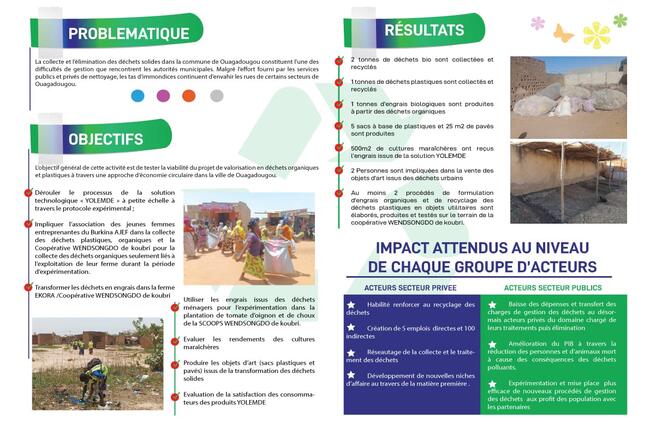
The ‘YOLEMDE’ project is an innovative waste management initiative set up in Ouagadougou, the capital of Burkina Faso. This solution is part of a sustainable development approach aimed at reducing the environmental impact of waste while creating new economic and social opportunities for the community.
The general objective of the YOLEMDE project is to recover organic and plastic waste through a circular economy approach in the city of Ouagadougou.
A- Project objectives
1. Waste reduction: Reduce the amount of solid waste in landfills and public spaces through sorting, reuse and recycling techniques.
2. Waste Recovery: Transform organic and plastic waste into reusable or marketable products such as compost for organic waste, plastic bags, school bench tables, plastic paving stones or recycled gadgets for plastic waste.
3. Community Awareness: Educate the population on the importance of recycling and waste management for a cleaner and healthier environment.
4. Job Creation: Generate local employment opportunities for collectors, sorters and artisans working in the recycling sector.
B- Methodology
The YOLEMDE project has several phases:
- Waste collection : Waste is collected from households, businesses and public places by a dedicated team of women (Association des jeunes femmes entreprenantes du Burkina AJFEB.
- Waste sorting: Waste is sorted according to its type (plastic, paper, metal, organic) to make it easier to process.
- Recycling and recovery: The sorted waste is taken to recycling centres where it is transformed into reusable materials.
- Marketing: Recycled products are sold on the local market, generating additional income for the project and its stakeholders.
The general objective of the YOLEMDE project is to recover organic and plastic waste through a circular economy approach in the city of Ouagadougou.
A- Project objectives
1. Waste reduction: Reduce the amount of solid waste in landfills and public spaces through sorting, reuse and recycling techniques.
2. Waste Recovery: Transform organic and plastic waste into reusable or marketable products such as compost for organic waste, plastic bags, school bench tables, plastic paving stones or recycled gadgets for plastic waste.
3. Community Awareness: Educate the population on the importance of recycling and waste management for a cleaner and healthier environment.
4. Job Creation: Generate local employment opportunities for collectors, sorters and artisans working in the recycling sector.
B- Methodology
The YOLEMDE project has several phases:
- Waste collection : Waste is collected from households, businesses and public places by a dedicated team of women (Association des jeunes femmes entreprenantes du Burkina AJFEB.
- Waste sorting: Waste is sorted according to its type (plastic, paper, metal, organic) to make it easier to process.
- Recycling and recovery: The sorted waste is taken to recycling centres where it is transformed into reusable materials.
- Marketing: Recycled products are sold on the local market, generating additional income for the project and its stakeholders.
Performance and impacts
- Reducing illegal dumping and making the city a healthier place to live.
- Reducing environmental pollution and greenhouse gas emissions.
- Creating value from waste, thereby contributing to a circular economy.
The ‘YOLEMDE’ project is thus positioning itself as a key player in the ecological transition in Ouagadougou, by promoting an innovative, sustainable and inclusive method of waste management.
- Reducing environmental pollution and greenhouse gas emissions.
- Creating value from waste, thereby contributing to a circular economy.
The ‘YOLEMDE’ project is thus positioning itself as a key player in the ecological transition in Ouagadougou, by promoting an innovative, sustainable and inclusive method of waste management.
Other data of interest
https://solve.mit.edu/challenges/learning-for-civic-action-challenge/solutions/70571