Network member
Technology sector
Infrastructure and Urban planning
Focal point email
Problem
Climate Change is Intensifying Urban and Environmental Vulnerabilities in Developing Nations
Developing countries face compounding environmental challenges due to rapid urbanization and climate change:
* Rising temperatures and frequent heatwaves are increasing energy demand and health risks.
* Air pollution from fine dust (PM2.5, PM10) is severely impacting public health.
* Water scarcity and polluted runoff degrade land and communities.
* Urban areas lack green infrastructure to absorb carbon, retain water, and support biodiversity.
* Local governments often lack access to proven, low-cost, and scalable climate solutions.
These challenges demand technologies that are not only effective, but also easily transferable, resource-efficient, and capable of being operated by local communities.
Developing countries face compounding environmental challenges due to rapid urbanization and climate change:
* Rising temperatures and frequent heatwaves are increasing energy demand and health risks.
* Air pollution from fine dust (PM2.5, PM10) is severely impacting public health.
* Water scarcity and polluted runoff degrade land and communities.
* Urban areas lack green infrastructure to absorb carbon, retain water, and support biodiversity.
* Local governments often lack access to proven, low-cost, and scalable climate solutions.
These challenges demand technologies that are not only effective, but also easily transferable, resource-efficient, and capable of being operated by local communities.
Solution
Supergreen – A Scalable, Low-Carbon Vertical Garden System Tailored for Local Deployment
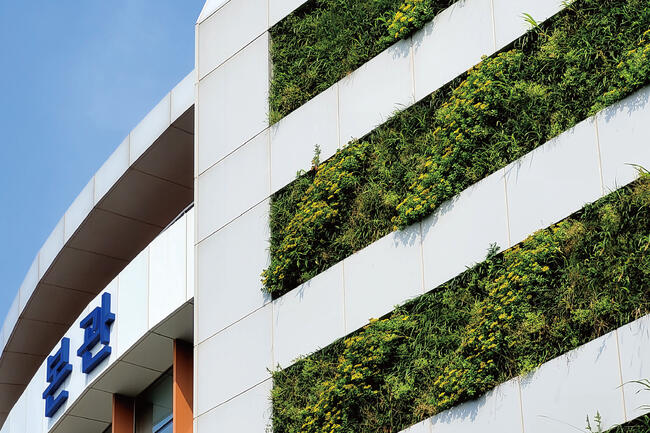
Supergreen, developed by CMI Corporation (Republic of Korea), is a modular, nature-based technology that transforms vertical surfaces into carbon-absorbing, water-managing, and biodiversity-restoring infrastructure.
Unlike conventional greening approaches, Supergreen is designed for cost-effective transfer to developing countries and ensures adaptability to diverse local conditions.
Key Features:
* Modular, Prefabricated Structure: adapts to buildings, fences, and freestanding structures. Locally fabricable using simple tools and training.
* Soilless Root-Control Planting System (Patented): ensures plant survival with minimal water and maintenance. Prevents root rot and allows for edible or medicinal plants.
* Smart Environmental Response (Optional): IoT sensors enable real-time monitoring of CO₂, PM, humidity, and temperature. Supports national climate tracking systems when needed.
* Stormwater and Water Recycling Function: captures and filters runoff up to 5 liters per minute, removes 82% of pollutants, and reduces heat transfer by 23%. Suitable for LID (Low Impact Development) integration.
* Off-Grid Ready: operable in remote or informal settings with low energy needs and solar compatibility.
Supergreen is not just a product - it is a climate adaptation platform that can be delivered alongside local training, certification programs, and community employment models.
Supergreen, developed by CMI Corporation (Republic of Korea), is a modular, nature-based technology that transforms vertical surfaces into carbon-absorbing, water-managing, and biodiversity-restoring infrastructure.
Unlike conventional greening approaches, Supergreen is designed for cost-effective transfer to developing countries and ensures adaptability to diverse local conditions.
Key Features:
* Modular, Prefabricated Structure: adapts to buildings, fences, and freestanding structures. Locally fabricable using simple tools and training.
* Soilless Root-Control Planting System (Patented): ensures plant survival with minimal water and maintenance. Prevents root rot and allows for edible or medicinal plants.
* Smart Environmental Response (Optional): IoT sensors enable real-time monitoring of CO₂, PM, humidity, and temperature. Supports national climate tracking systems when needed.
* Stormwater and Water Recycling Function: captures and filters runoff up to 5 liters per minute, removes 82% of pollutants, and reduces heat transfer by 23%. Suitable for LID (Low Impact Development) integration.
* Off-Grid Ready: operable in remote or informal settings with low energy needs and solar compatibility.
Supergreen is not just a product - it is a climate adaptation platform that can be delivered alongside local training, certification programs, and community employment models.
Performance and impacts
Verified by National Testing and Real-World Implementation
Supergreen has been tested and certified by Korean Conformity Laboratories (KCL), Public Procurement Service (PPS), and SHCC.
Key performance metrics include:
* Carbon Absorption: up to 50 ppm per square meter per hour.
* Fine Dust Filtration: removes up to 120 micrograms per square meter per hour (PM2.5 and PM10).
* Temperature Reduction: reduces surface temperatures by up to 4.2°C.
* Humidity Stabilization: maintains relative humidity between 60% and 65%.
* Water Runoff Management: retains up to 5 liters per minute of runoff and removes 82% of pollutants.
* Plant Survival Rate: verified 99.9% survival in a 3-year real-environment pilot in Songdo, Korea.
Socio-Economic Impacts:
* Facilitates green job creation through local technician training.
* Enhances climate resilience in public spaces such as schools, clinics, and housing.
* Supports alignment with SDGs, NDCs, and GCF reporting through measurable environmental data.
Supergreen has been tested and certified by Korean Conformity Laboratories (KCL), Public Procurement Service (PPS), and SHCC.
Key performance metrics include:
* Carbon Absorption: up to 50 ppm per square meter per hour.
* Fine Dust Filtration: removes up to 120 micrograms per square meter per hour (PM2.5 and PM10).
* Temperature Reduction: reduces surface temperatures by up to 4.2°C.
* Humidity Stabilization: maintains relative humidity between 60% and 65%.
* Water Runoff Management: retains up to 5 liters per minute of runoff and removes 82% of pollutants.
* Plant Survival Rate: verified 99.9% survival in a 3-year real-environment pilot in Songdo, Korea.
Socio-Economic Impacts:
* Facilitates green job creation through local technician training.
* Enhances climate resilience in public spaces such as schools, clinics, and housing.
* Supports alignment with SDGs, NDCs, and GCF reporting through measurable environmental data.
Other data of interest
* Recognized as a Government-certified Innovative Product by Korea PPS (2024).
* Deployed at more than 70 public sector sites, including National Assembly offices.
* Winner of the Good Design Award (Ministry of Trade) and listed as a Green Procurement Priority Product.
* Includes an educational component via a Vertical Garden Specialist Certification Program.
* Fully aligned with UN SDG goals:
* SDG 11: Sustainable Cities and Communities
* SDG 13: Climate Action
* SDG 6: Clean Water and Sanitation
* SDG 15: Life on Land
"Supergreen offers more than greenery - it offers a replicable, inclusive, and evidence-based pathway for developing nations to achieve climate resilience and sustainable development.“
* Deployed at more than 70 public sector sites, including National Assembly offices.
* Winner of the Good Design Award (Ministry of Trade) and listed as a Green Procurement Priority Product.
* Includes an educational component via a Vertical Garden Specialist Certification Program.
* Fully aligned with UN SDG goals:
* SDG 11: Sustainable Cities and Communities
* SDG 13: Climate Action
* SDG 6: Clean Water and Sanitation
* SDG 15: Life on Land
"Supergreen offers more than greenery - it offers a replicable, inclusive, and evidence-based pathway for developing nations to achieve climate resilience and sustainable development.“