Network member
Technology sector
Early warning and Environmental assessment
Website
Focal point email
Problem
The damages caused by tropical cyclones have intensified due to climate change, with particularly severe impacts on developing countries along the Pacific coast, in Southeast Asia, and the Caribbean. These regions - many of which are partner countries of GI E&S - share common vulnerabilities and challenges in managing cyclone-related disasters. The key problems include:
• Lack of Tropical Cyclones Monitoring and Forecasting Infrastructure:
Most national meteorological agencies in these regions lack dedicated, ICT-based systems for tropical cyclone monitoring and forecasting. As a result, they rely heavily on fragmented tools, open-source software, and outdated methods, which hampers the timely delivery of accurate warnings.
• Institutional Limitations:
Forecasting responsibilities are often scattered across multiple departments or underfunded units within government agencies. This structural fragmentation weakens national disaster preparedness and response mechanisms.
• Severe Capacity Gaps:
Many institutions lack adequately trained personnel capable of conducting satellite-based cyclone analysis, generating high-resolution forecasts, or managing real-time emergency information dissemination. In several countries, meteorological satellite data is underutilized due to technical and human resource constraints.
• Lack of Tropical Cyclones Monitoring and Forecasting Infrastructure:
Most national meteorological agencies in these regions lack dedicated, ICT-based systems for tropical cyclone monitoring and forecasting. As a result, they rely heavily on fragmented tools, open-source software, and outdated methods, which hampers the timely delivery of accurate warnings.
• Institutional Limitations:
Forecasting responsibilities are often scattered across multiple departments or underfunded units within government agencies. This structural fragmentation weakens national disaster preparedness and response mechanisms.
• Severe Capacity Gaps:
Many institutions lack adequately trained personnel capable of conducting satellite-based cyclone analysis, generating high-resolution forecasts, or managing real-time emergency information dissemination. In several countries, meteorological satellite data is underutilized due to technical and human resource constraints.
Solution
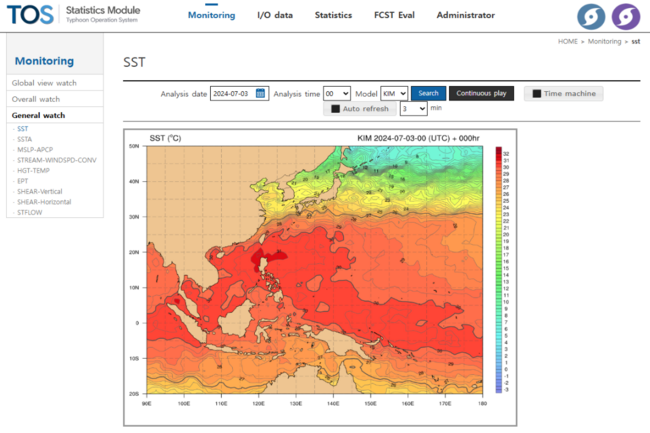
GI E&S offers an ICT-based Integrated Platform for Tropical Cyclone Monitoring and Forecasting, adapted from Korea’s Typhoon Operation System (TOS). The platform strengthens forecasting and disaster response through real-time data integration, satellite analysis, and automated dissemination.
1) Integrated Platform Components:
• Typhoon Operation System (TOS)
Integrates satellite imagery (GK-2A, Himawari-8), radar, AWS, and NWP data to enable analysis, track prediction, intensity estimation, and public alert dissemination.
• Satellite Data Analysis System (DAS)
Supports cyclone detection and validation using raw satellite data for early-stage analysis and forecasting support.
2) Additional Solutions from GI E&S:
• Capacity-Building Program
Includes local and invitational training, expert dispatch, and hands-on support to build national forecasting capabilities.
• ODA Project Development Consulting
Assists with proposal design, alignment with climate policies, and mobilization of ODA or climate finance.
1) Integrated Platform Components:
• Typhoon Operation System (TOS)
Integrates satellite imagery (GK-2A, Himawari-8), radar, AWS, and NWP data to enable analysis, track prediction, intensity estimation, and public alert dissemination.
• Satellite Data Analysis System (DAS)
Supports cyclone detection and validation using raw satellite data for early-stage analysis and forecasting support.
2) Additional Solutions from GI E&S:
• Capacity-Building Program
Includes local and invitational training, expert dispatch, and hands-on support to build national forecasting capabilities.
• ODA Project Development Consulting
Assists with proposal design, alignment with climate policies, and mobilization of ODA or climate finance.
Performance and impacts
GI E&S’s integrated platform has delivered measurable improvements in cyclone forecasting and disaster response capacity through:
1) Advanced Forecasting and Operational Systems
• Improved accuracy of cyclone tracking and intensity forecasting using integrated satellite, radar, AWS, and NWP data.
• Enabled real-time analysis, ensemble forecasting, and GIS-based visualization through a centralized, automated platform tailored to each country’s needs.
2) Capacity Strengthening
• Conducted in-country and overseas training for forecasters and ICT staff.
• Supported long-term sustainability through expert dispatch and practical system training.
3) Enhanced Disaster Preparedness
• Enabled timely public alerts and improved government response to tropical cyclone events.
• Strengthened protection for vulnerable communities through faster and more reliable early warnings.
These impacts have been realized/or planed to be implemented through projects in:
• Lao PDR: GeoKompsat-2A Satellite System
• Cambodia: GK-2A Analysis Tools Deployment
• Philippines (USD 6M, 2022–2025, PAGASA)
• Viet Nam (USD 9.3M, 2023–2026, VNMHA)
1) Advanced Forecasting and Operational Systems
• Improved accuracy of cyclone tracking and intensity forecasting using integrated satellite, radar, AWS, and NWP data.
• Enabled real-time analysis, ensemble forecasting, and GIS-based visualization through a centralized, automated platform tailored to each country’s needs.
2) Capacity Strengthening
• Conducted in-country and overseas training for forecasters and ICT staff.
• Supported long-term sustainability through expert dispatch and practical system training.
3) Enhanced Disaster Preparedness
• Enabled timely public alerts and improved government response to tropical cyclone events.
• Strengthened protection for vulnerable communities through faster and more reliable early warnings.
These impacts have been realized/or planed to be implemented through projects in:
• Lao PDR: GeoKompsat-2A Satellite System
• Cambodia: GK-2A Analysis Tools Deployment
• Philippines (USD 6M, 2022–2025, PAGASA)
• Viet Nam (USD 9.3M, 2023–2026, VNMHA)
Other data of interest
Potential for Scaling
This solution can be adapted and customized to various national contexts based on:
• Geographic exposure to tropical cyclones
• Available ICT infrastructure and satellite access
• Synergies with national climate adaptation or digital government agendas
The platform supports seamless expansion to other meteorological hazards related to tropical cyclone, including flood forecasting, heavy rainfall analysis, and integrated disaster early warning systems.
This solution can be adapted and customized to various national contexts based on:
• Geographic exposure to tropical cyclones
• Available ICT infrastructure and satellite access
• Synergies with national climate adaptation or digital government agendas
The platform supports seamless expansion to other meteorological hazards related to tropical cyclone, including flood forecasting, heavy rainfall analysis, and integrated disaster early warning systems.